What is EECP therapy?
EECP stands for enhanced external counterpulsation. You lie on a padded bed with inflatable cuffs wrapped around your calves, thighs and hips. The cuffs inflate in quick sequence, from the calves upwards, in the moment your heart relaxes between beats, and deflate just before the next beat. An ECG tracks your heart rhythm so the timing stays exact.
The squeeze pushes blood back towards the heart when it is filling, and the release lowers the load just as the heart pumps. The aim is to support circulation and the work the heart does, without needles, incisions or medication.
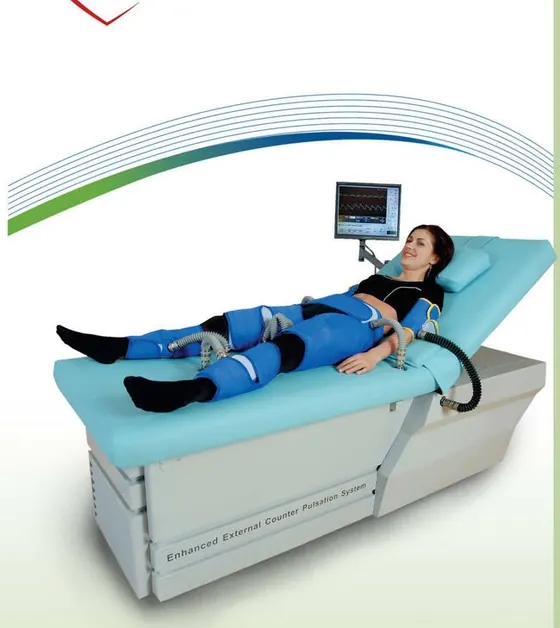
What happens in an EECP session
- Screening first. Before any session we review your health history and medications, and we work with your doctor's guidance. EECP is only offered to people it is suitable for.
- Getting set up. You lie down in comfortable clothes. We fit the leg cuffs and ECG sensors and check your blood pressure.
- The session. The cuffs inflate and deflate with each heartbeat. Most people describe a firm, rhythmic hug moving up the legs. You can read, listen to music or rest.
- Afterwards. We check how you feel and record your readings. You can usually go straight back to your day.
How long does an EECP course take?
The course most often used in studies is 35 one-hour sessions, five days a week for about seven weeks. Your own plan is set after screening.
Who EECP therapy is for
EECP has been studied most for people with stable angina (chest pain from reduced blood flow to the heart) whose symptoms continue despite medication and who are not candidates for further procedures. US heart guidelines from the American College of Cardiology and American Heart Association say EECP may be considered for relief of this kind of refractory angina. Researchers have also looked at other uses, with less settled results.
At Medical Fitness NZ, CardioFlow is provided for appropriate clients following screening and clinical guidance. If you have a heart condition, your GP or cardiologist is the right first conversation, and we are happy to work alongside them.
Is EECP treatment safe?
EECP is non-invasive and is generally well tolerated. Common side effects are mild: skin rubbing or tenderness under the cuffs and tiredness after early sessions. It is not suitable for everyone. Providers usually screen out people with, for example, some irregular heart rhythms, significant aortic valve disease, recent heart procedures, a history of deep vein thrombosis, severe leg artery disease, very high blood pressure or pregnancy. This is why screening and clinical guidance come first.
Does EECP therapy work?
The evidence is real but modest. Trials and registries report fewer angina episodes and better exercise tolerance for many patients, while systematic reviews describe the randomised evidence as limited. We talk this through honestly at your consultation, so you can decide with your doctor whether EECP fits your plan.
EECP compared with cardiac rehabilitation and exercise
| EECP | Cardiac rehabilitation | Supervised exercise programme | |
|---|---|---|---|
| What it is | Leg cuffs timed to the heartbeat while you lie still | A hospital or clinic programme of exercise, education and support after a heart event | Prescribed exercise, coached and progressed over time |
| Effort needed | None: you rest during sessions | Gradual exercise matched to your recovery | Builds as your fitness improves |
| Usual length | About 35 one-hour sessions | Several weeks, set by your care team | Ongoing |
| Where it fits | For selected people after screening, alongside medical care | Usually recommended by your hospital team after a heart event | For most people, with clearance where needed |
EECP does not replace cardiac rehab, medication or your doctor's plan. For many people the best path combines approaches, for example a VO2 max and metabolic test to set safe training zones, then a coached exercise programme.
How much does EECP therapy cost?
Medical Fitness NZ does not use a one-size-fits-all price. The cost of EECP depends mainly on how many sessions your plan needs (a full course is about 35 sessions) and what screening is involved. We explain our recommendation and its price clearly at your consultation, before you decide.
Where to get EECP treatment in Auckland
CardioFlow EECP is offered through Medical Fitness NZ, opening soon at 170 Parnell Road, Auckland. Register for Founding Access online, or call us on 09 307 2080, for priority appointments and a complimentary Discovery Consultation, with no obligation to continue.
Frequently asked questions
What does EECP stand for?
Enhanced external counterpulsation. Cuffs on the legs inflate and deflate in time with your heartbeat to support blood flow.
Does EECP hurt?
Most people find it comfortable. It feels like a firm, rhythmic squeeze moving up the legs, and some people get mild skin soreness under the cuffs early in the course.
Do I need a referral for EECP?
We screen everyone first and work with your doctor's guidance. Bring details of your heart condition and medications to your consultation.
How many EECP sessions will I need?
The course most often used is 35 one-hour sessions over about seven weeks. Your own plan is set after screening.
Is EECP covered by insurance in New Zealand?
Cover varies by insurer and policy. Check with your insurer before you start.
About this page
This page is written by The Exercise Room, the Parnell gym behind Medical Fitness NZ, where CardioFlow EECP is provided for appropriate clients following screening and clinical guidance. Last reviewed November 2026. The description of EECP and its evidence comes from published heart guidelines and health technology reviews. It is general information, not medical advice: please talk to your doctor about your own heart health. Spot something to correct? Email info@theexerciseroom.co.nz.